
PEPSI Throughput Efficiency
The overall efficiency of echelle spectrographs is typically ≈10% including the telescope (and typically at the laser wavelength of 532 nm). The PEPSI optical train contains up to 66 optical surfaces from the telescope’s primary mirror down to the CCDs: 64 in the blue train and 66 in the red train. However most of these surfaces are immersed, e.g., the PFUs have 22 surfaces for the 200 μm and 300 μm fibers, of which only one surface is a reflection in air and two more are transmissions with air. The 100 μm fibers have no reflection in air at all. Similar is the case for the spectrograph with 32/34 surfaces (blue/red) but only 5 reflections with air. Its efficiency alone (including the CCD) is 32% and includes aperture losses, Fresnel scatter, coating transmission, vignetting, and internal transmissions. The table below (from Strassmeier et al., 2015) tabulates the efficiency budget for every component in the optical train at three different wavelengths, as well as the composition and coating of the components.
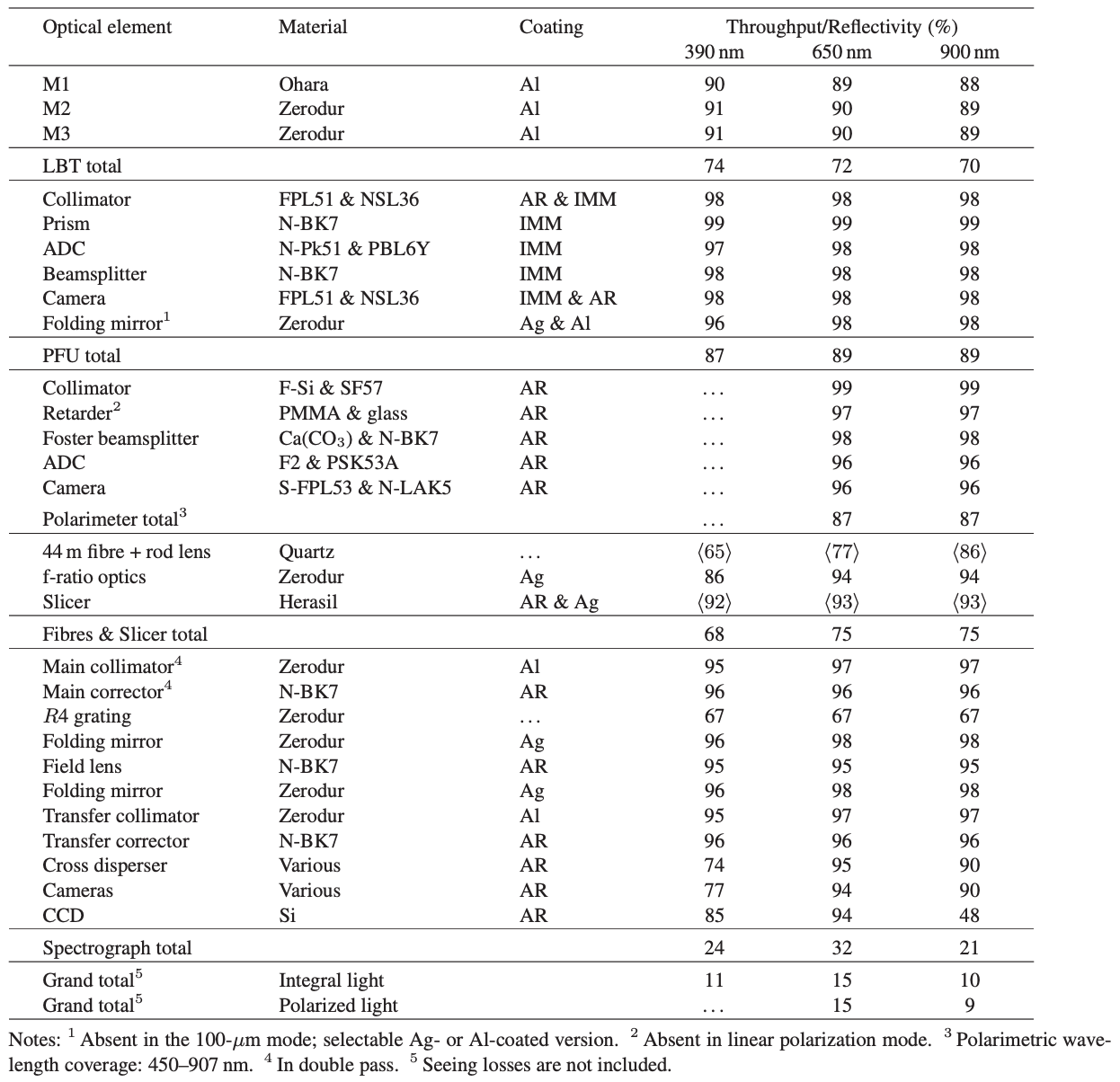
Abbreviations: Al aluminum, Ag silver, AR anti-reflection, IMM immersed.
The measured PEPSI system throughput efficiencies (i.e., telescope + instrument, but not atmospheric losses) in percent are shown below along with notes, with the most recent results on the top.
September 2025
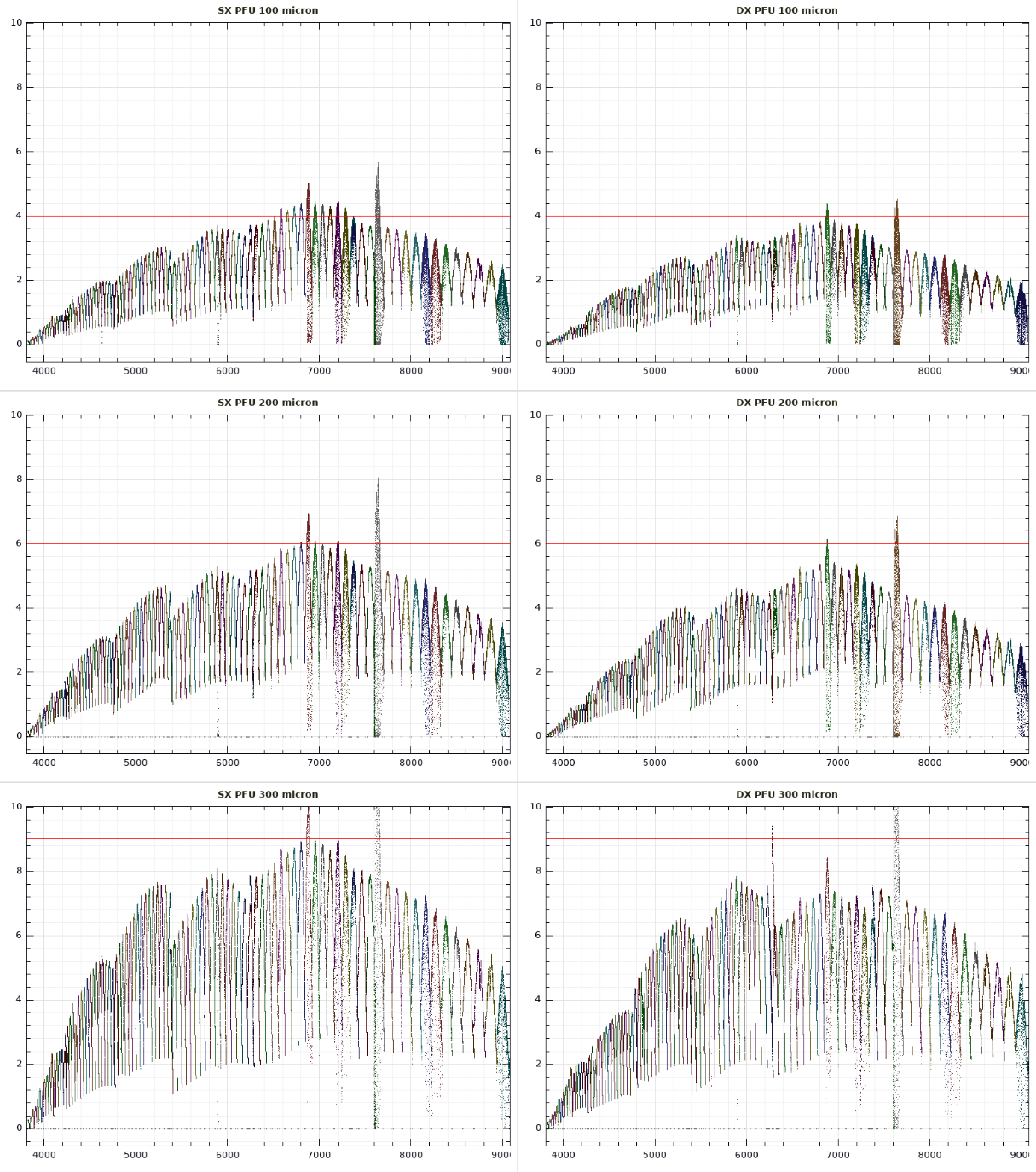
System efficiency in percent beyond Earth atmosphere at LBT with PEPSI PFU SX/DX with 58Aql V=5.6 (A0 III) and seeing conditions 0.8″. Both ASM M2s are installed.
September 2024
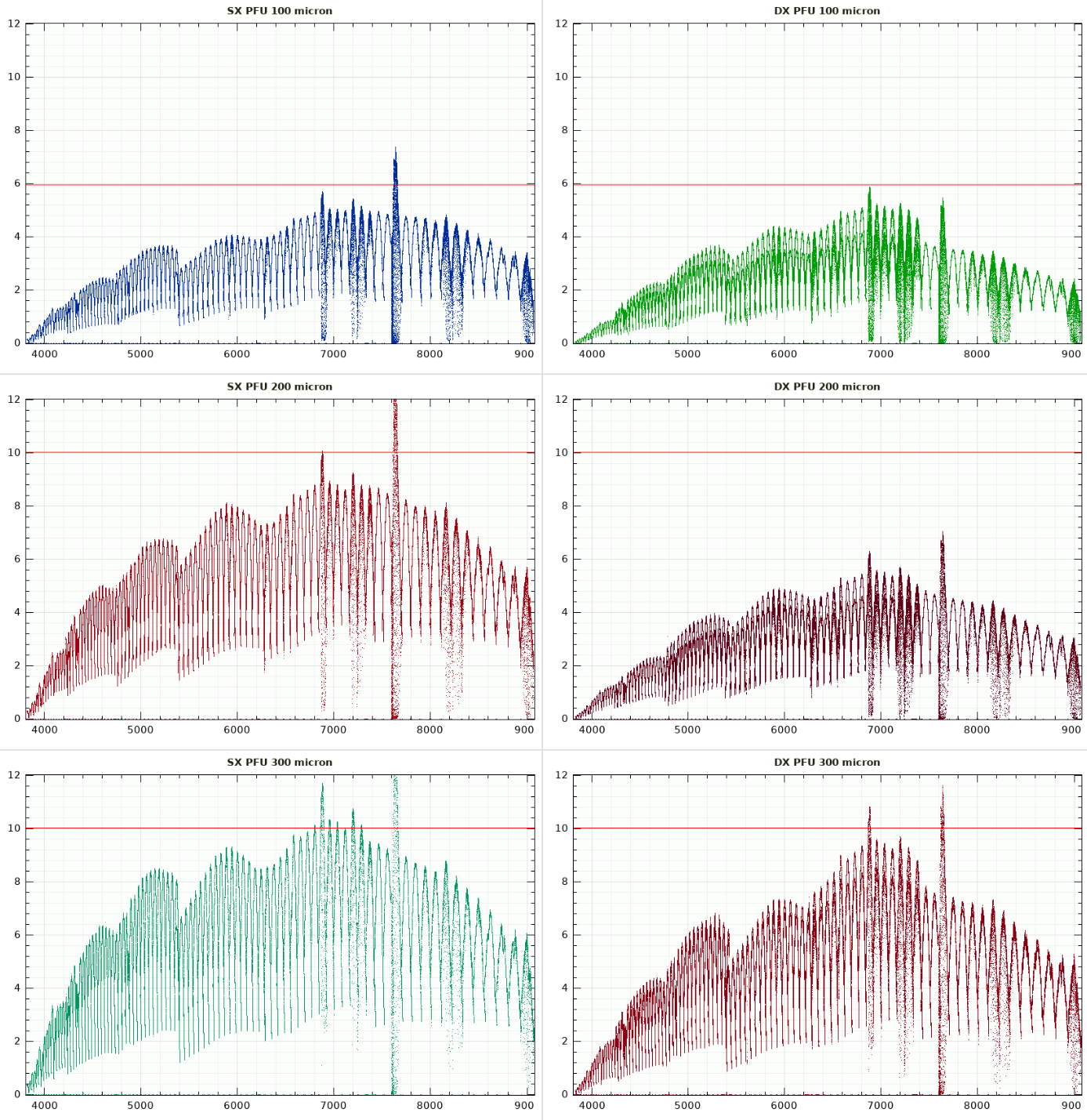
System efficiency in percent beyond Earth atmosphere at LBT with PEPSI PFU DX and rigid M2 with three flux standards for redundancy: HR 7950 V=3.7 (A1 V) on 20240919, HR 8634 V=3.4 (B8.5 V) on 20240923, HR 718 V=4.3 (B9 III) on 20240929, and HR 1544 on 20241012. Seeing conditions were 1.1″ and 0.5″ with clear sky. The efficiency is slightly lower than in 2023 possibly due to lower reflectivity of rigid M2. The new fiber injection unit was installed in September 2024.
September 2023

System efficiency in percent beyond Earth’s atmosphere at LBT with PEPSI PFU. Two flux standard stars were observed for redundancy: HR 718 V=4.3 (B9 III) and HR 9087 V=5.1 (B7 III) on September 8, 2023. Seeing conditions were 0.5/0.6″ on the two sides with clear sky. LBT mirrors recoated during 2023 summer shutdown: DX M1+M3, SX ASM M2. PEPSI fiber heads were cleaned and attached to the fiber injection optics with a refractive index matching solution. The two new STA1600 CCDs were also installed at this time. Overall gain is 1.5-2 as compared to September 2022.
September 2022

System efficiency in percent beyond Earth atmosphere at LBT with HR153 V=3.7 (B2 IV) flux standard with the seeing correction on pinhole transmission for PFU on September 3, 2022 after SX M1 mirror aluminization and SX PFU science fiber bundle being squashed. Only CD5 was used due to problem with CDB. The results are consistent with efficiencies measured in June 2022. No notable difference was seen after the summer shutdown showing the fiber efficiency is unchanged.
June 2022

System efficiency in percent beyond Earth atmosphere at LBT with HR 7950 V=3.78 (A1 V) flux standard with the seeing correction on pinhole transmission for PFU in May 29, 2022 and after SX/DX fiber bundle replacement in April 2022.
September 2021
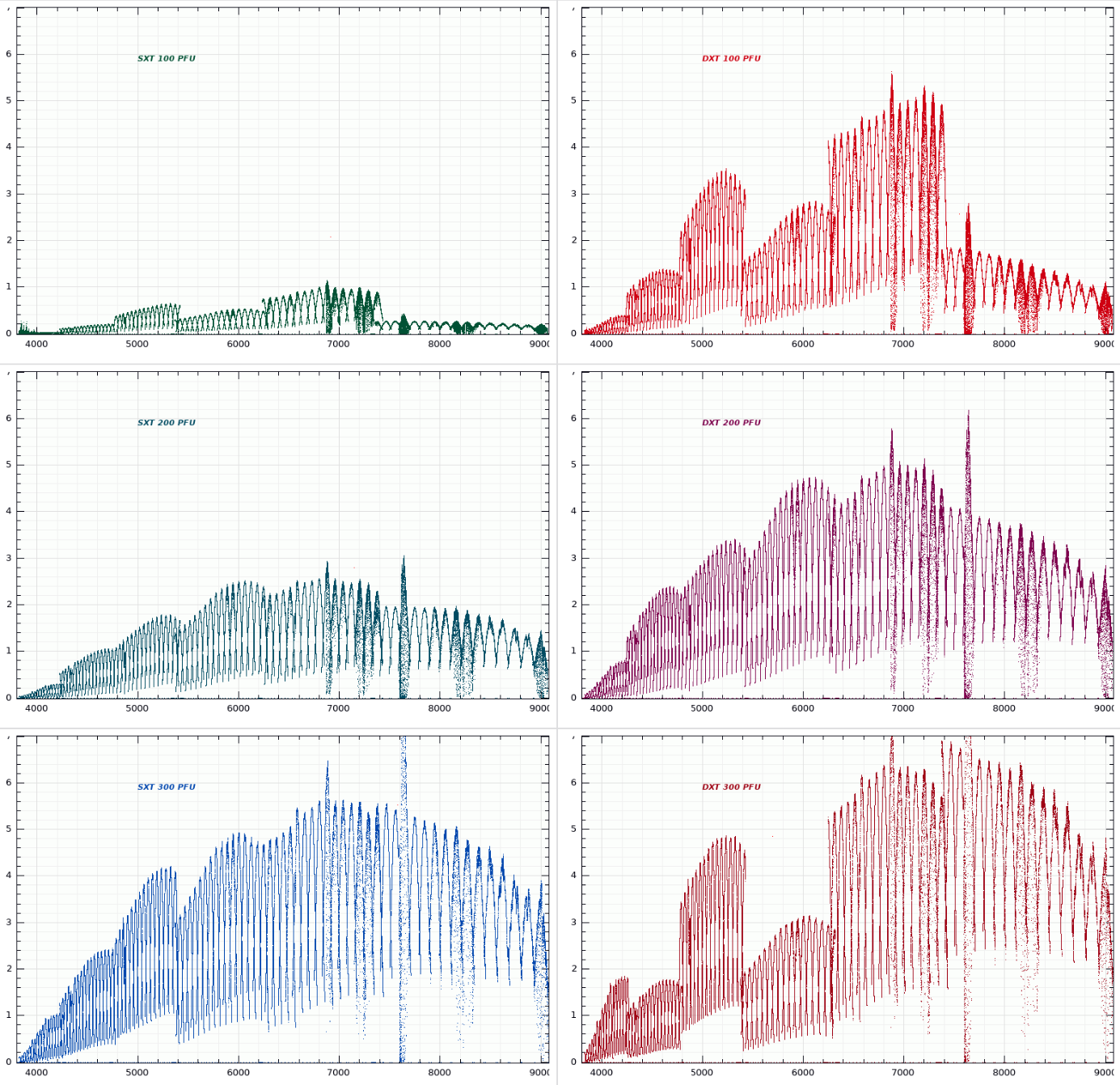
System efficiency in percent beyond Earth atmosphere at LBT with HR 8634 (B8 V) flux standard with the seeing correction on pinhole transmission for PFU in September 2021 with the SX fiber bundle transmission degradation.
November 2019
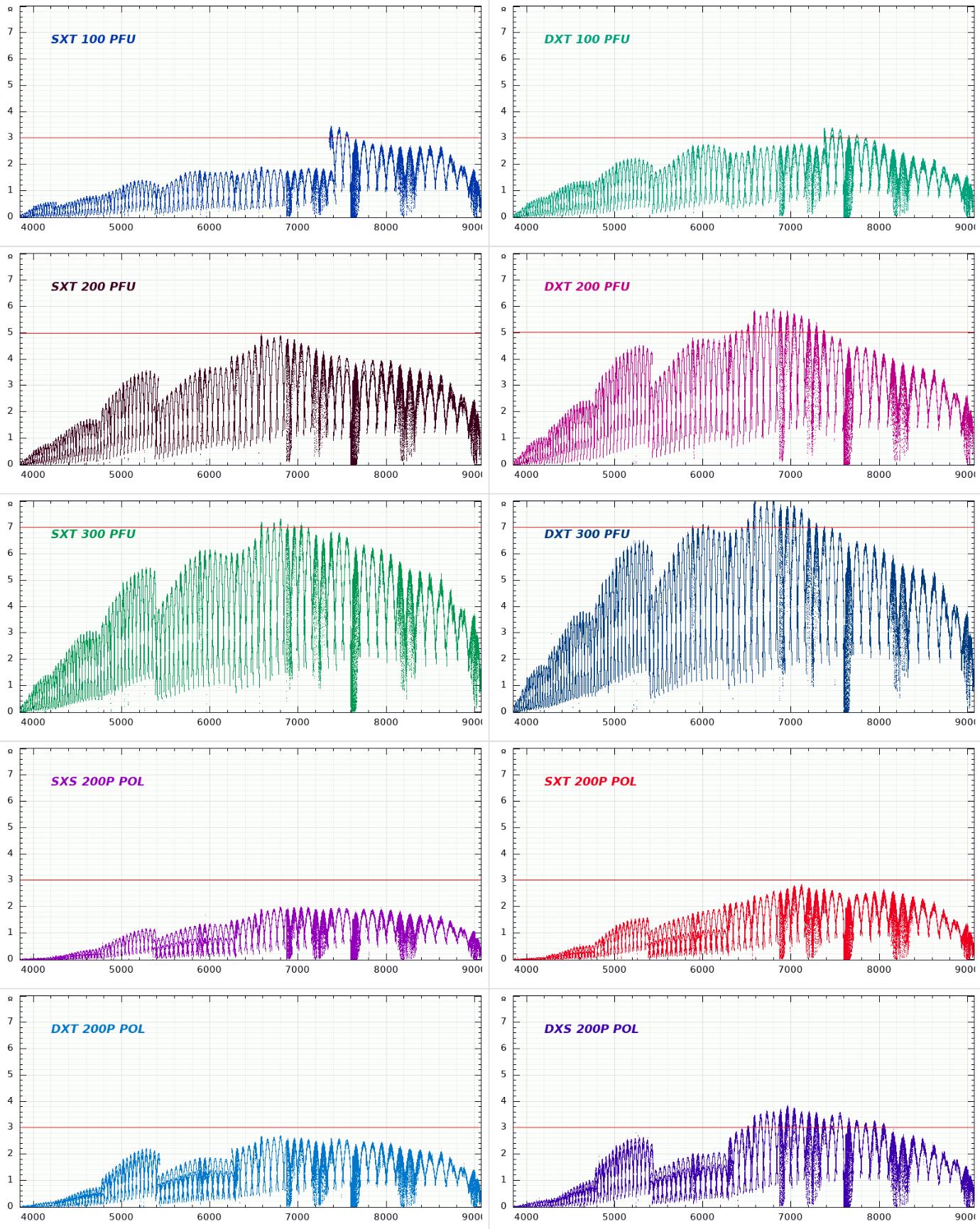
System efficiency beyond Earth atmosphere at LBT with HR 153 (B2 IV) flux standard with the seeing correction on pinhole transmission for PFU in November 2019 and POL in May 2019. The total POL efficiency is SX=SXS+SXT and DX=DXS+DXT as the light is divided by half by the Foster prism. Note a sharp edge between CD3 and CD4 at 5500 Angstroms. The efficiency in overlapping orders is co-added.
May 2017
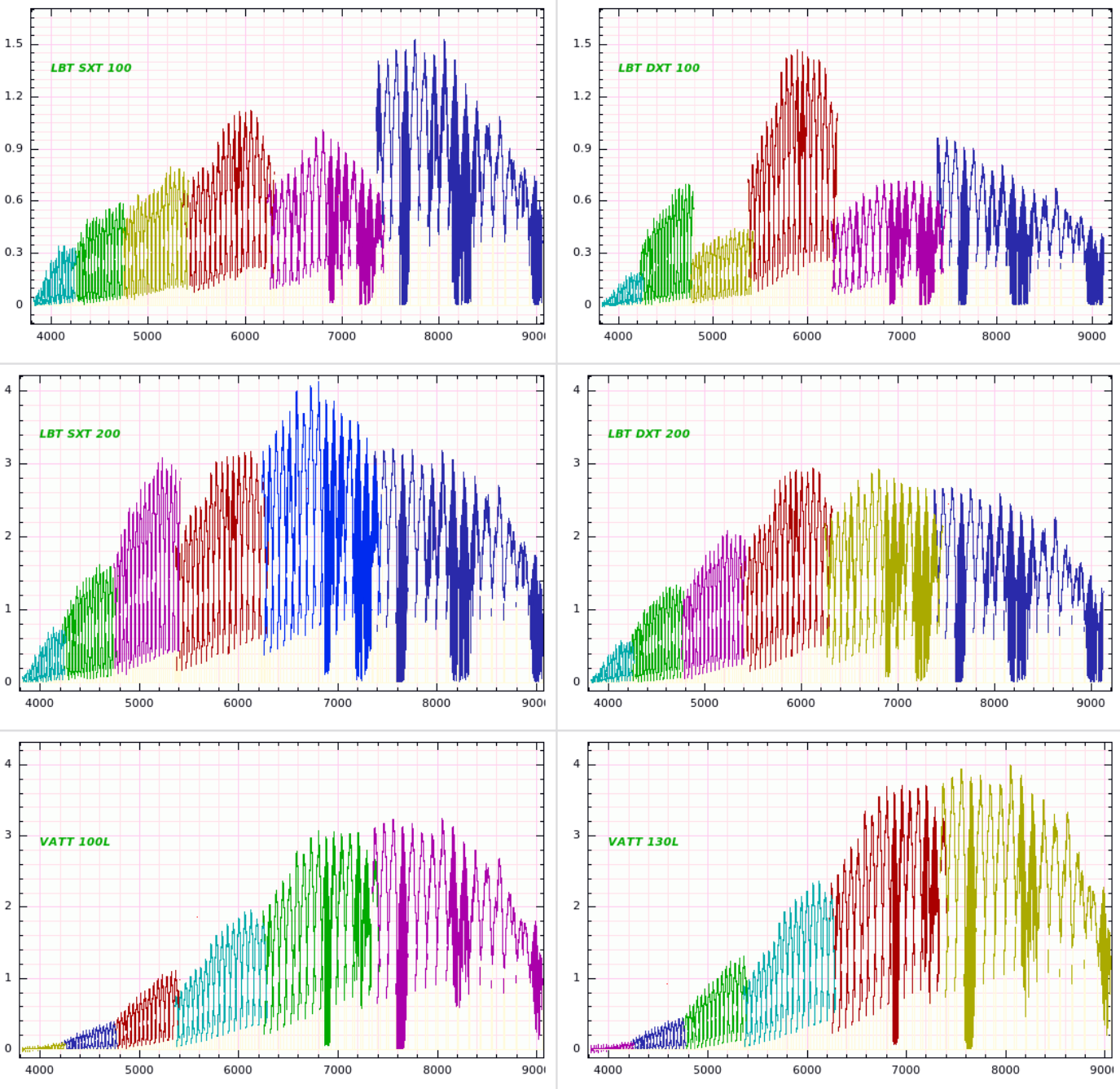
System efficiency beyond Earth atmosphere at LBT and VATT with HR 4554 as the flux standard in May 2017 with the seeing of about 1″. The drops in the efficiency at some CDs are due to guiding jitters. The average pinhole transmission for 100 μm fiber are 45% (2.2 times light loss) and 30% (3.3), and for 200 μm fiber are 72% (1.4) and 75% (1.3).
June 2016
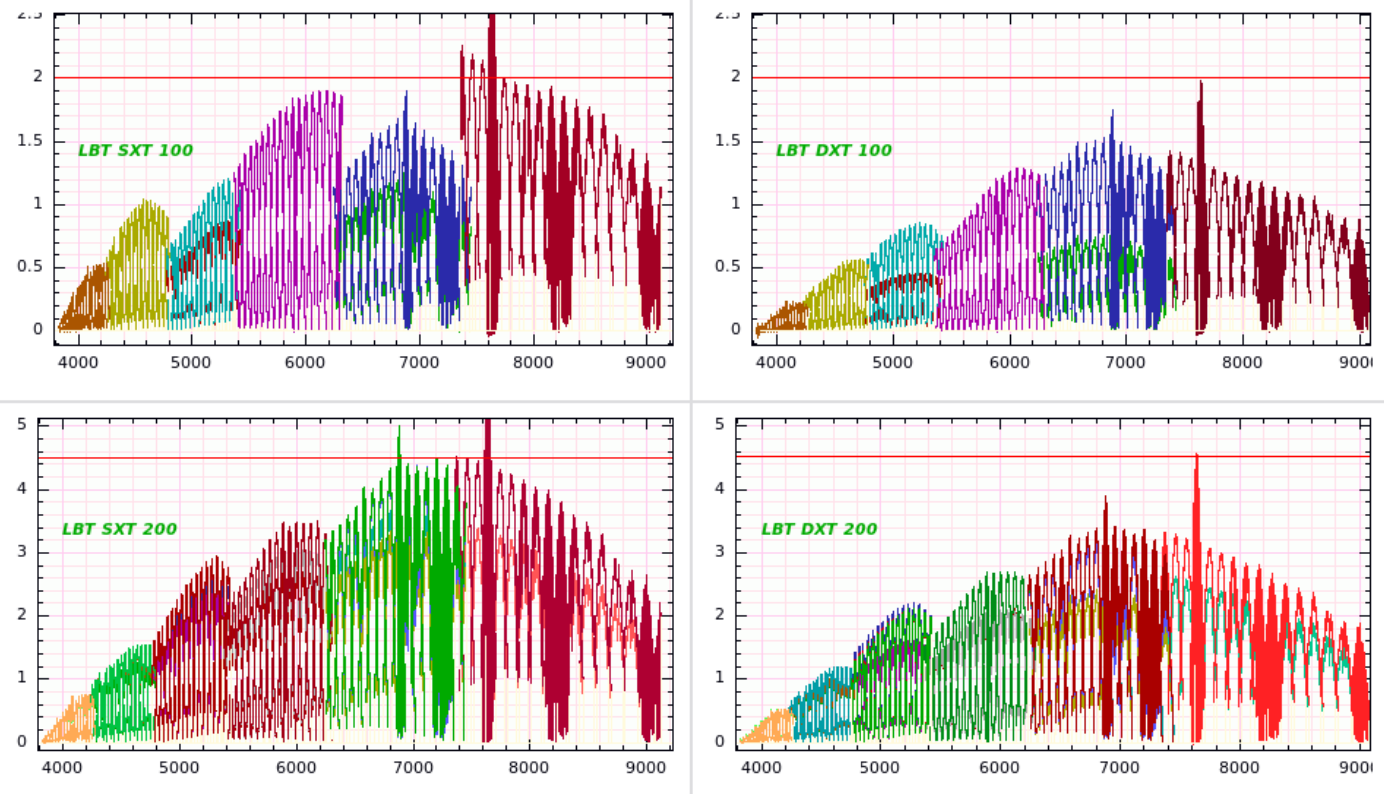
System efficiency beyond Earth atmosphere at LBT with 58 Aql as the flux standard in June 2016 with the seeing of 1.1″.
April 2015
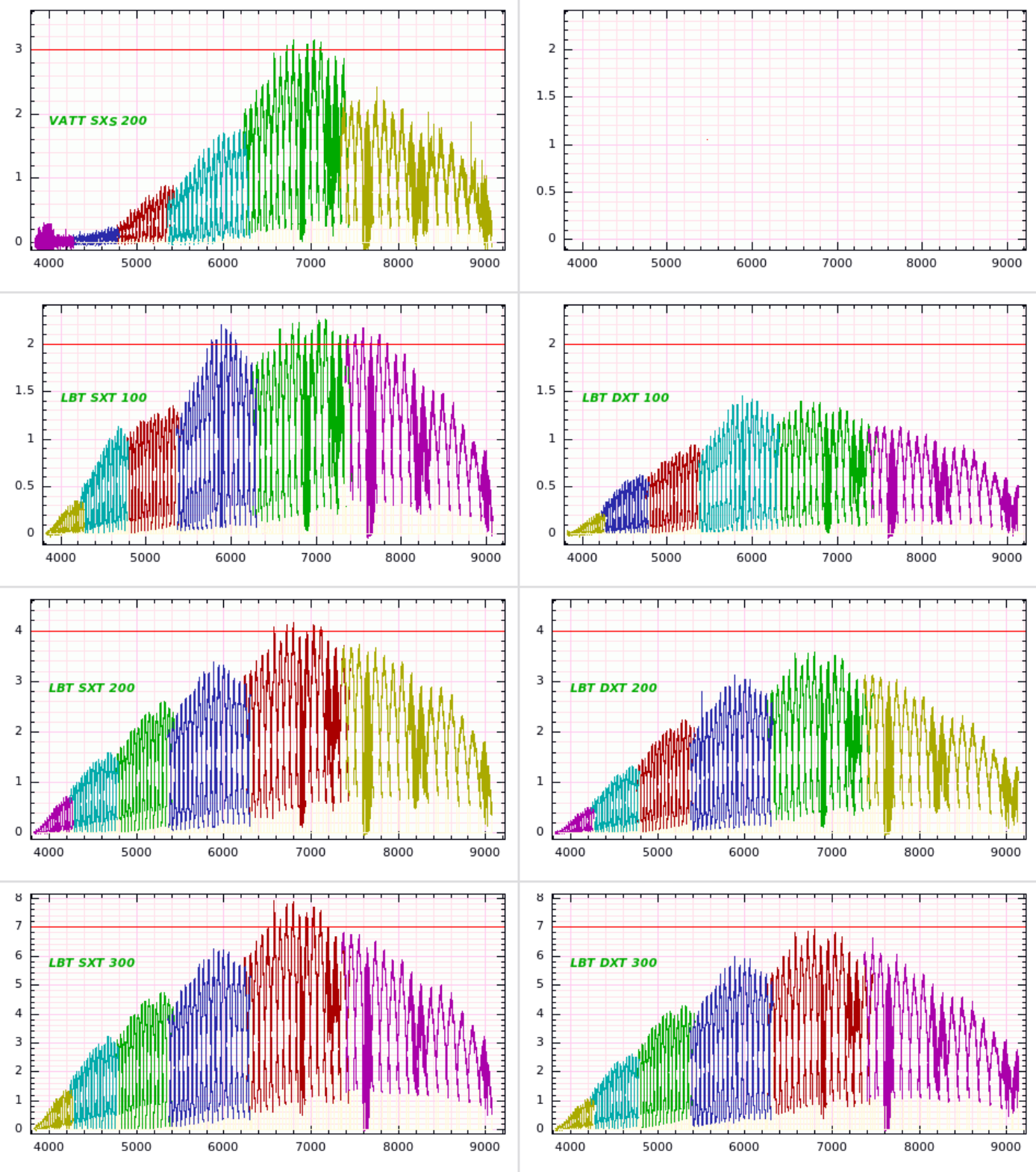
System efficiency beyond Earth atmosphere at VATT and LBT with HD 93521 as the flux standard in April 2015.