
Beam Splitters
Just below the ADC is a turret wheel containing the beam splitters that send part of the light 90 deg. to the AGW unit for acquisition, guiding, and wavefront sensing, and (most of) the rest of the light passes straight through to the fiber injection unit.
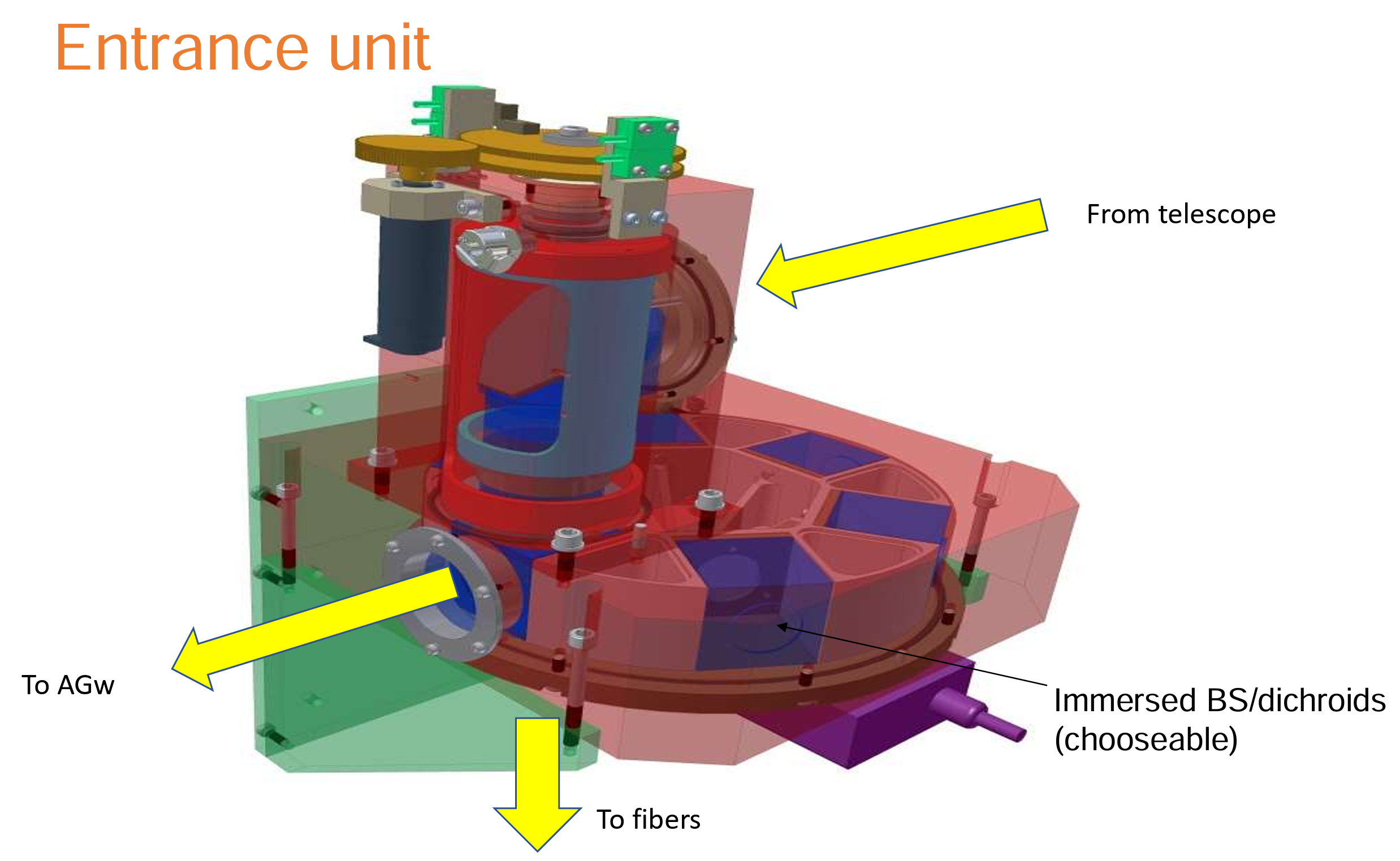
In the fiber injection unit, around each fiber head is a mirrored surface that reflects “spillover” light that isn’t injected into the fiber back up towards the beam splitter.
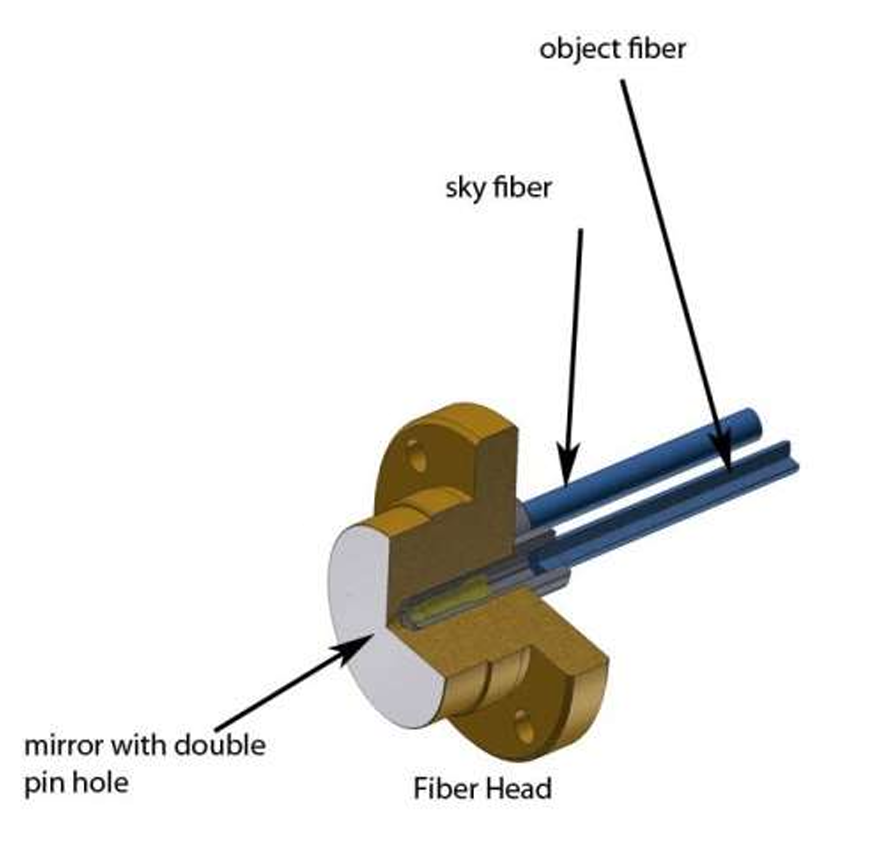
This “back-reflected” spillover light is then reflected twice by the beamsplitter onto the AGW camera, and is physically offset from the “main” light reflected into the AGW. The purpose of this back-reflected light is to ensure the target is properly centered on the fiber head.
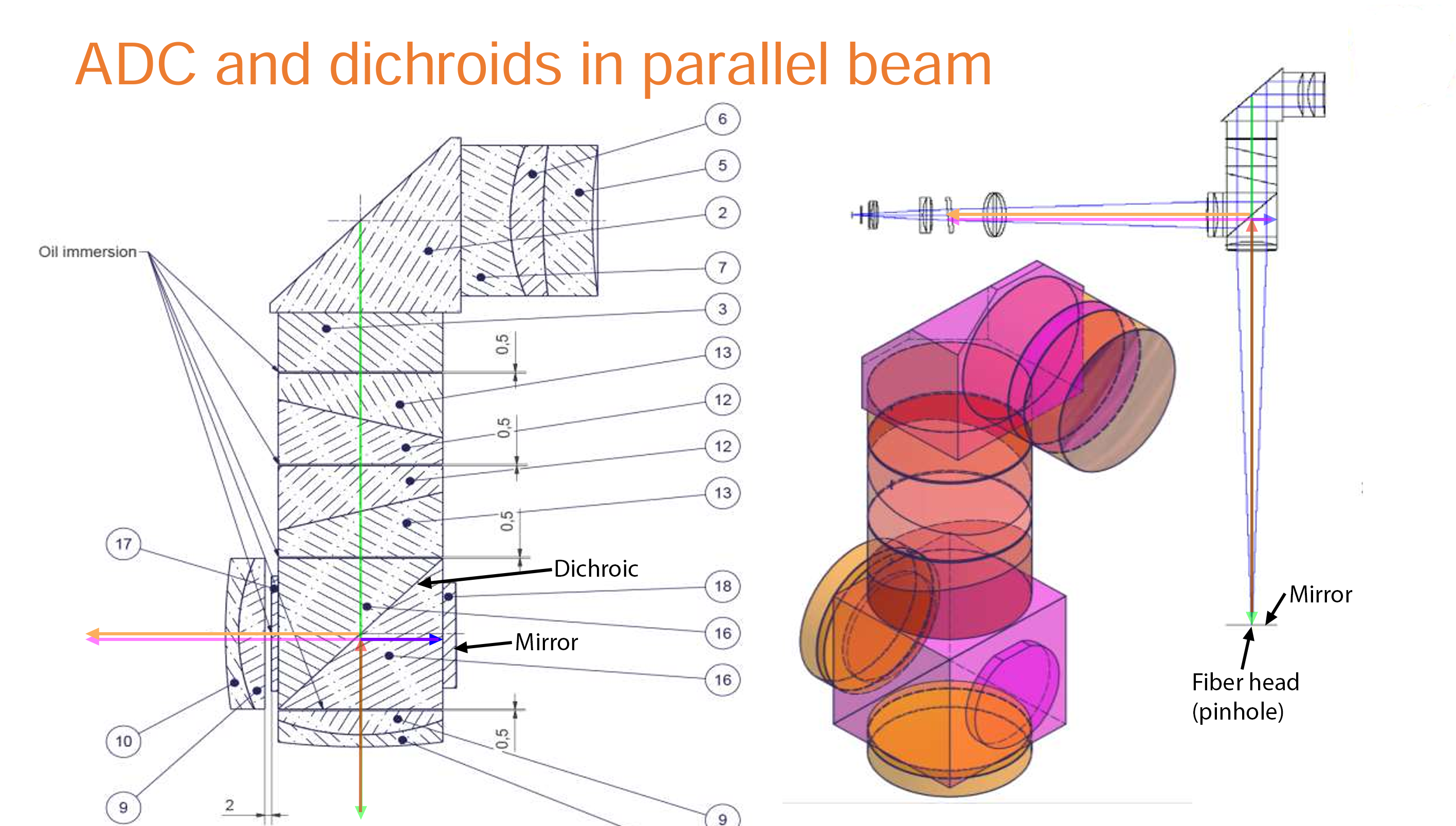
The above diagram illustrates the optical path for light entering the AGW (left) and the fiber head (bottom). The green arrow represents light from the telescope, of which some is reflected by the beam splitter dichroic directly to the AGW (orange arrow). The rest of the beam (green) continues through the dichroic, most of which enters the fiber head. The back-reflected spillover light is represented by the red arrow, which reflects again off the dichroic (blue), then reflecting off of one final mirror and into the AGW (magenta). As a result the AGW camera sees two images of the target: a direct image as well as an image of the spillover light from the fiber head. These images are physically offset from one another on the AGW CCD due to the beams hitting the dichroic in slightly different locations.
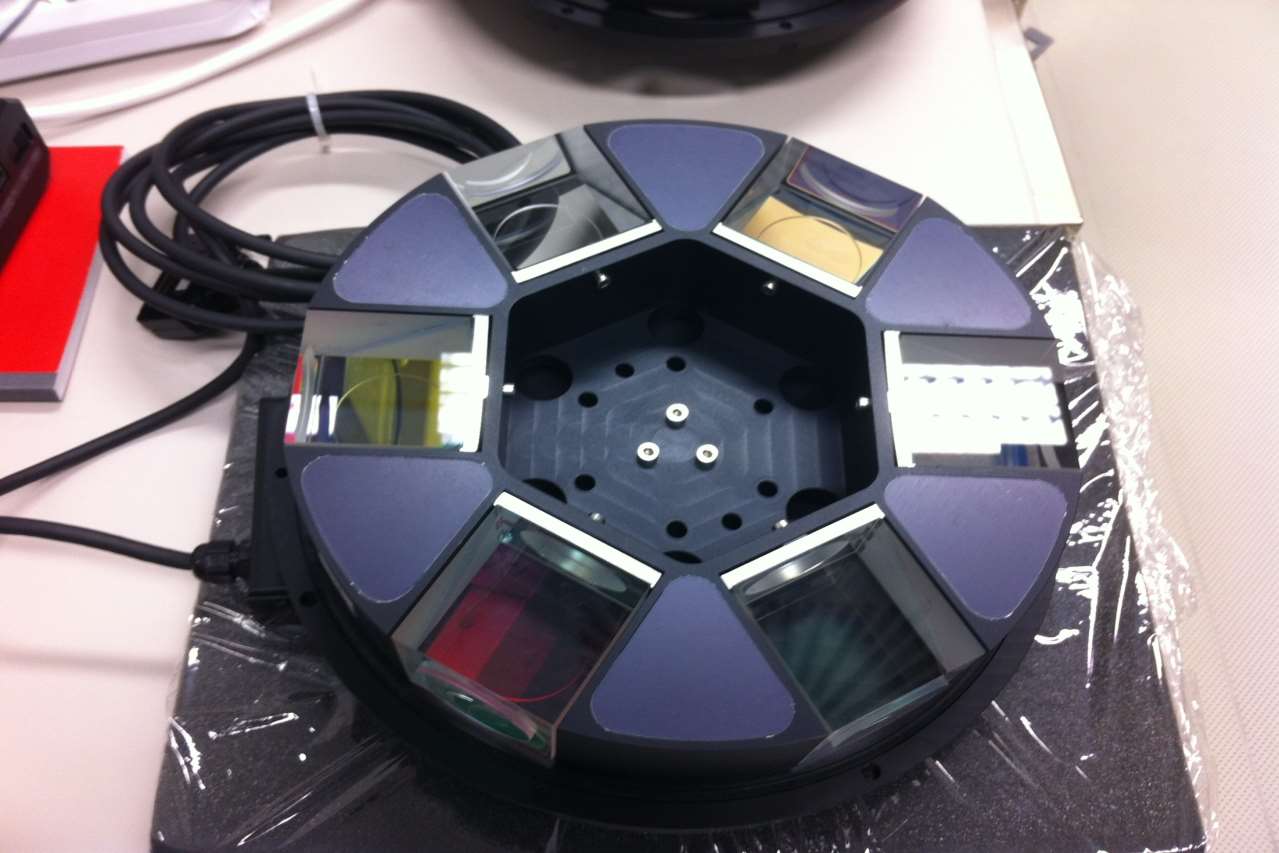
There are 5 different beam splitters for observing (and one for engineering) that are all optimized for the red cross dispersers, where the choice depends on the brightness of the target and the cross dispersers to be used. Fortunately for the user, the PFU beam splitter is automatically selected according to the brightness of the target and desired cross-disperser pair(s) when the target list is uploaded to the PEPSI computer. As a summary:
- BS1 – for all wavelengths with bright targets – 2% of science light reflected to guider across all CDs
- BS2 – for blue wavelengths – 10% of science light reflected to guider redward of 720nm
- BS3 – for very blue or very red wavelengths – 15% of science light reflected to guider between 560-740nm
- BS4 – for blue wavelength faint targets – same as BS2 but 50% of science light reflected to guider redward of 750nm
- BS5 – for very blue or very red wavelength faint targets – same as BS3 but 50% of science light reflected to guider between 560-740nm
- BS6 – for engineering usage only – reflects 100% of science light to AGW
In the plot below the beamsplitter transmission going to the science camera (green), reflection to the AGW camera (red), and back-reflection to the AGW camera (blue) as a function of wavelength is shown:

Note that the Y-axis scaling for reflectance and back-reflectance may be different and is labeled on the right side of the plots, and the vertical dotted lines denote the wavelength cutoffs for each CD. Also the short wavelength cutoff of the BS1 reflectance curve is due to a measurement issue, the curve does extend all the way to the left. The diagram below helps visualize the optimal beam splitters to use for each CD, remembering that BS4 and BS5 are for fainter targets:

For the field lenses, the solid line is the notch wavelength, however the transmission is good at wavelengths above and below the dotted lines. The blue field lens (default) reflects 98.9% of blue light below 479nm and transmits 97% of the red light above 537nm. The red field lens reflects 99.1% of the blue light below 542nm and transmits 97% of the red light above 625nm. The current optimal configurations for the beam splitters as a function of CD and magnitude are:
| Vmag Range | CD I | CD II | CD III | CD IV | CD V | CD VI |
|---|---|---|---|---|---|---|
| 0-14 | BS#1 | BS#1 | BS#1 | BS#1 | BS#1 | BS#1 |
| 14-17 | BS#2 | BS#2 | BS#3 | BS#2 | BS#2 | BS#3 |
| 17-18* | BS#4 | BS#4 | BS#5 | BS#4 | BS#4 | BS#5 |
*NOTE: Based on current experience the faintest magnitude the guider (which guides on source) can guide on is about V=18 mag under ideal conditions (clear, sub-arcsecond seeing, new moon, point source), with the highest binning and longest exposure time.