Science News
Restricted LUCI1-AGw1 Guider Patrol Field (resolved)
Posted Mar 04, 2023
Update Jan 10 2024: The issue was resolved during SSD23 and the AGw patrol field is back to the nominal area described in the LUCI pages (here). The problem was traced to the camera cable, where a couple of wires were broken but the disconnection only manifested at certain positions in the patrol field.
Update June 30: Despite yesterday’s additional inspection, testing, and re-seating an accessible cable for the guide camera, last night we had another dropout of the guide camera right at the limit established in March. For normal observing I would still recommend avoiding guide stars at all dither positions landing in the red shaded area in the plot. When planning your observations in the OT, use the inflection point at left (marked in the diagram below) where the theta stage limit and the 5.5 arcminute Gregorian focal plane radius intersect as a reference.
When observing, the symptom of encountering this problem is a “no guide star found” error when otherwise it should be there. The only remedy is to select a better-positioned guide star and start the observations over.
AGw1_GStars_2023Mar
March 2023: We have identified a position-dependent electrical problem in the AGw1 (LUCI1) off-axis guider camera. It is most likely in the cable between the guider CCD and the controller box. This cable is inaccessible on the telescope, so until we can schedule a repair it will be necessary to ensure that any off-axis guide stars (and all the dither positions used!) avoid moving into the upper third of the AGw patrol field (see below).
When planning your observations in the OT, use the inflection point at left (marked in the diagram below) where the theta stage limit and the 5.5 arcminute Gregorian focal plane radius intersect. If you have any questions please send them to us at scienceops@lbto.org.
Resolved: PEPSI Blue CD Position Issue
Posted Feb 10, 2023
Resolved with PEPSI SSD2023 upgrade and work.
Update 2023-02-10
The blue CD is degrading its operational performance: now it cannot be re-positioned from UMAC at all. It can no longer move down to CD1. It only can traverse between CD2 and CD3 through manual operations. The blue cross disperser has been moved to CD2 and will be left in this configuration. Further work in the future may be done if CD3 is required. The bottom line: CD1 is not available.
The two new Linear Stages from Feinmess/Steinmeyer Mechatronik Dresden are promised to be delivered in May/June. They have to be tested first at AIP and delivered to LBT in August.
Original Post 2022-09-19
The position of the PEPSI Blue Cross Disperser is unreliable and it is recommended to take calibrations before changing configurations. This can mean significant downtime, ~ 25 min per blue configuration change if needed. We recommend setting up such that a single blue configuration per night is used. This allows the Blue CD selection to be set and verified during the day. Any questions, please contact sciops@lbto.org.
Even-odd bias level instability in the lower right quadrant of MODS1B
Posted Dec 20, 2022
There is an intermittent issue affecting the lower right quadrant (Q2) of MODS1B, where the counts in even and odd channels differ by hundreds of ADU (>~450 ADU). Because of the readout strategy employed: the detector is read out by four amplifiers, each through two output chains, one for the even and the other for the odd columns, there is normally some vertical striping seen in the raw images, since the bias and gain of the two chains do not match perfectly. However when this issue arises, the striping dominates the raw image. (In pixel and imaging flats where the average count levels are high >15k ADU, however, the effect can go unnoticed in the raw data and appears only in differences or ratios with good images).
This instability is transient and can affect the entire quadrant or only a fraction of rows, as the examples below show.
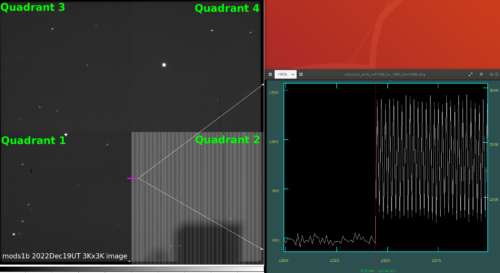

Figure 1: On the left, a MODS1 Blue 3K x 3K image with the entire quadrant 2 affected. A cut on line 1000 from column 1500 to 1600 (magenta bar in image) illustrates the larger than normal even-odd level difference in quadrant 2. The dark rectangular shadow is of the guide probe. On the right, a raw full frame 8K x 3K MOS spectrum with a fraction of quadrant 2 affected.
This issue first arose in February 2022, but then its frequency tapered off and it was not seen from April through the end of the semester. It came back in mid-October and is intermittent.
On full frame images where the entire Q2 is affected, modsCCDRed will remove the pattern, as it uses the bias levels in the 48-column prescan region. When only a fraction of rows are affected, however, a more customized approach is needed. When only a portion of the detector is read out (3K x 3K, 1K x 1K images or 4K x 3K prism), there is no prescan region to use to remove the effect.
We have not identified the cause or measures to take to stop the behavior, but will update this note if and when we do.
Persistence effect on LUCIs
Posted Oct 14, 2022
There appears to be a temporary change in the persistence behavior of the LUCI detectors. After an observation of Saturn, from data collected on 20220906 (simple sum of the dithered Saturn data), persistence is still visible a month later (20221013):

This effect is more prominent on the LUCI2 detector. LUCI1 is on the Left image above and LUCI2 on the right. The feature manifests as a depressed persistence signal.
For LUCI2: The counts in the Saturn feature (~27ADU) are lower than just outside of it (~52 ADU). This is much lower than the counts in the quarter-circle feature at bottom right (~100ADU) of the above image. This is measured on a dark frame taken immediately after K band exposures averaging ~33k ADU (~60% full well).
There are some other structures on the dark exposure that look like trails from a bright star as the telescope moved around (e.g. curve to the left of the Saturn dice-5). This feature should come out with normal data reductions. It is suggested that people take calibrations in a timely fashion to science data taken.
Instrument Status Post SSD 2022
Posted Sep 19, 2022
- LBC’s: Released for Science
- TMS: Released in shared risk
- LUCI’s: Released for Science
- SX AO: Diffraction limited and ESM in all modes are released in shared risk.
- MODS: Released for Science
- PEPSI PFU: Released with Caveat – Blue CD Position issue
The following summarizes the work done to the facility instruments during summer shutdown 2022, and the status of those instruments post restart:
LBC’s
Both LBCs have been checked out and are operating nominally. During the summer shutdown, the filters and the accessible lenses (L1 front and back & the front of L2) were cleaned. As far as the LBC operation, no changes have been noted since last semester. There is a flaw in the guiding code which may affect guiding non-sidereal targets where the rate x exposure time is greater than ~2″ and an image jump may be seen. We are working to release an updated version of the LBC SW that will prevent spurious guide corrections; after that, NS targets will be guided until their rate x exposure time is ~2″, after which they will not be guided, but no image jumps should be seen.
The TMS (telescope metrology system) fibers, collimators and retroreflectors were all installed and the system was checked out closed-dome, however weather and time did not cooperate to complete a full on-sky checkout of the system during the engineering nights. It has since been used for one half-night, and no issues were seen. The intention is to continue to use the TMS system with the LBCs during partner science nights in a shared risk capacity, as was done last semester.
LUCI’s
The G150 grating was removed from LUCI1 this summer and replaced by the G040 grating, making the grating configurations in the 2 LUCI’s identical. The release of the G040 grating is pending commissioning. While LUCI1 was off telescope, the entrance window was cleaned, removing the internal debris noted last semester. Maintenance and internal inspections were completed, including a detailed inspection of the detector focus mechanism. LUCI2 remained on telescope.
All standard tests of LUCI1 and LUCI2 were completed after the summer shutdown. The new transforms and field aberration calculations were all confirmed.
All science modes for LUCI1 and LUCI2 have been calibrated and verified closed dome including:
 G210/N1.8 – L1/L2
- G210/N3.75 – L1/L2
- G200/N3.75 – L1/L2
- G200/N1.8 – L1/L2
- N1.8 imaging – L1/L2
- N3.75 imaging – L1/L2
- N30 Imaging – L1
Seeing limited imaging and G210/N1.8 spectroscopy were verified on sky, and typical science cases with G200/N1.8 spectroscopy and N30 imaging are pending on sky verification. All modes are released with a note that additional sky time is desired for further verification.
AO
The SX Adsec was removed for the repair of 10 detached magnets, restoring full functionality at the edge. DX Adsec was also briefly removed for some critical maintenance.
The DX Adsec was checked out fully for seeing limited operations. LUCI AO or TTM is not an available mode at this time, and still in the commissioning phase.
The SX Adsec was recalibrated for seeing limited operations. The diffraction limited and ESM operations were verified closed-dome for all binnings. On-sky checkouts of bin1 and bin2 were completed during the restart but this was prior to the generation of updated NCPA tables. New tables have been generated and are in the process of verification. All diffraction limited and ESM modes are released for science in shared risk until additional on-sky tests are completed.
MODS
MODS1 and MODS2 were installed on Sept 20, 2022. All of the mechanisms have been exercised and are working well. Images have been taken with the guide and WFS cameras, and over a hundred biases and calibration test images have been taken closed-dome.
On Sep 25 UT, we were able to perform the on-sky checkout, checking the AGw alignment and verifying that the rotator zero point, which aligns the slits and masks along the N/S axis for PA=0, has not changed, so the AGw stage-to-sky transforms from last year are still usable. The night was clear and we obtained data on a spectrophotometric standard. The instruments are performing well, though we have noted a few bad readouts with MODS2B (4 of ~250 images) and continue to see intermittent readout delays for both MODS1R and, now also, MODS2B.
During the summer, a team from OSU (Mark Derwent, Dan Pappalardo, and Mike Engelman) came to the LBT to work on repairing the slitmask cassettes, both of which had sustained damage in the past year, and on preparing ready-to-go spares that will make replacement of the dichroic, filter wheel,and grating wheel pinion gears, if needed, faster and easier. They are adding steel sensor detection targets to the mask frames which will enable a larger sensor gap and make the mechanism more robust against the type of failure experienced last year. The slitmask cassette in MODS2 can once again be loaded to capacity, though in MODS1 a bent loading chute is effectively removing 2 custom positions until it can be fixed. The optics were inspected and dusted off before the instrument was mounted. Flat field images taken show no significant debris except for a spot on the MODS1 dichroic, but this has a special multi-layer coating and cleaning is on hold until we settle on a safe way to do it.
Other
The SX primary was realuminized and DX primary washed this year. The SX m3 was recoated this year as well.
Unveiling the population of dual and lensed active galactic nuclei at sub-arcsec separations
Posted Sep 13, 2022
Unveiling the population of dual and lensed active galactic nuclei at sub-arcsec separations is an exciting Nature paper featuring the LBT AO system at work. The team describes a new selection method to obtain a sample of dual/lensed active galactic nuclei (AGN) candidates with sub-arcsecond separations from the Gaia data. This method looks for AGNs showing multiple peaks in the light profiles observed by the Gaia satellite. This new method, dubbed the Gaia Multipeak method. (GMP), substantially increases the known number of dual AGNs, with implications for studies of in-spiraling supermassive black holes. High resolution images of a sample of GMP candidates are obtained with the LBT with spatial resolutions ~0.1″, revealing the presence of multiple targets with separations between 0.33-0.66″, confirming the method. Studies of these dual and lensed AGN’s are of importance in many field in astrophysics and cosmology, including but not limited to, understanding the nature of dark matter and measurement of the Hubble constant.

High-resolution, AO-assisted LBT images of 5 GMP-selected systems in the Ks band. Each panel is 2.2″× 2.2″ wide. The labels report the redshift
of the primary component and the angular separation.
The paper is available here:
https://www.nature.com/articles/s41550-022-01761-5
Unveiling the population of dual and lensed active galactic nuclei at sub-arcsec separations
F. Mannucci, E. Pancino, F. Belfiore, C. Cicone, A. Ciurlo, G. Cresci, E. Lusso, A. Marasco, A. Marconi, E. Nardini, E. Pinna, P. Severgnini, P. Saracco, G. Tozzi & S. Yeh
Nature Astronomy
Published: 25 August 2022